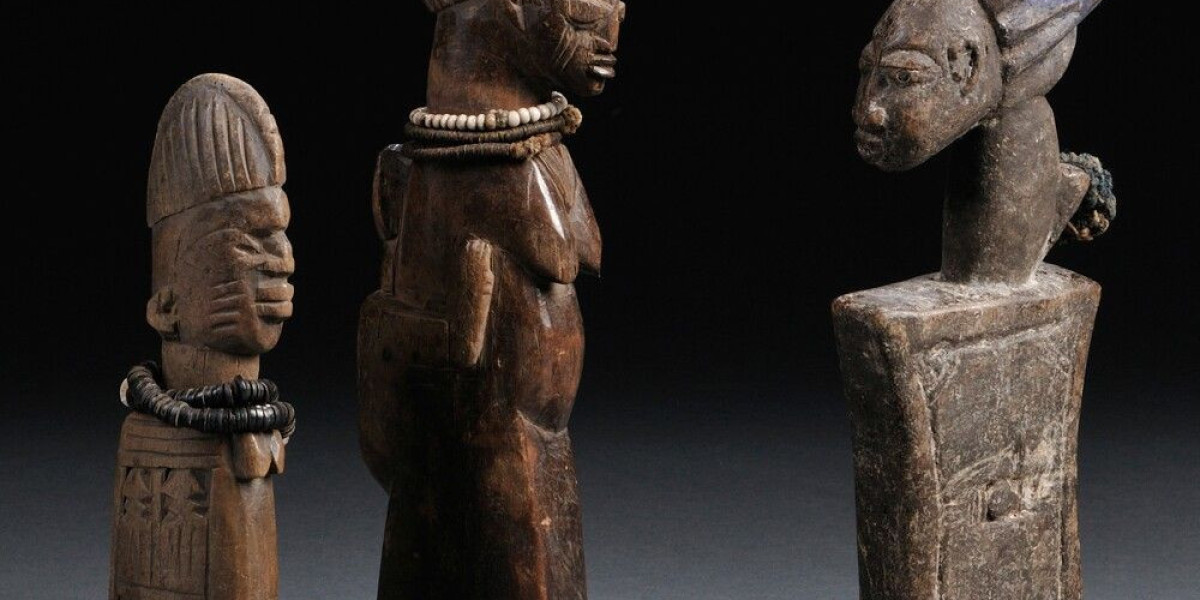
Asante Society
By the 18th century, the Asante had evolved into a highly stratified society. The nobility and courtiers of the king were the sikapo, meaning “people of wealth” in the Twi language. The king and the aristocracy often wore so much gold that they needed special servants to support their limbs. The Asante upper class owned vast estates and hundreds of slaves. Lower-class free people were known as ahiato, who were noticeably shorter than the aristocracy. For the most part, they lived in single-story huts and engaged in agriculture.
Slavery was a fact of life in Asante society, and trading slaves with the Europeans was important to the Asante economy. Slaves could lead brutal lives, particularly those who worked in the gold mines or in agriculture. Slaves were rarely offered the dignity of a burial, but simply disposed of after passing.
However, not all slaves were of the same status, as there were many levels of servitude. Some individuals served as indentured labourers for specified periods of time. Liberated slaves could be perfectly integrated into Asante society, where it was often considered taboo to ask about one’s family origins. There was a proverb, “Obi nkyere obi ase,” meaning that no one should disclose the origins of another person. Freemen could become influential persons in their community; this was the biggest distinction between European chattel slavery and the slavery practised by Akan societies.
The majority of the gold in the kingdom was the personal property of the Asantehene, and when wealthy sikapo died, only a small portion of their gold went to their heirs— the rest went to the king.
Asante law was enforced by a police force that monitored those who entered and left the kingdom. Punishment could be severe and could involve mutilation or execution. Although the Ashante practised traditional Akan religion, Muslim advisors from Sahel kingdoms and Arabs were common in court.
The Asante Empire in 1750
Asantehene Opoku Ware died in 1750, the same year Bach passed in Leipzig. In this year, the Asante Empire stretched far northwards into the Sahel region, encompassing 100,000 square miles and three million subjects (greater than the contemporary population of the 13 American colonies). No other state in West Africa possessed such wealth and power. However, trouble was brewing on the horizon. The Fante Federation of States had emerged in the immediate coastal region outside Elmina, and was moving to control coastal trade with Europe. The Fante were allied to the British, who resented Asante’s move to interfere with Fante trade.
The millions of Asante subjects had varying degrees of loyalty to the Asantehene. Outside of the power base in Kumasi, various Akan peoples still held deep local loyalties, and client chiefs had much autonomy. In the north, the non-Akan peoples of Gonja and Dagomba deeply resented Asante rule. As European rulers became increasingly invested in local politics, there were many potential sources of trouble for the Asante King. At the same time, no other kingdom in Africa held so much power. When Osei Kwadro took the throne in 1764, the future of the Asante people looked bright.
THANKS VERY MUCH FOR READING THE ARTICLE. FOLLOW FOR MORE AFRICAN HISTORIES.
KWAMZ TV GOT YOU COVERED.