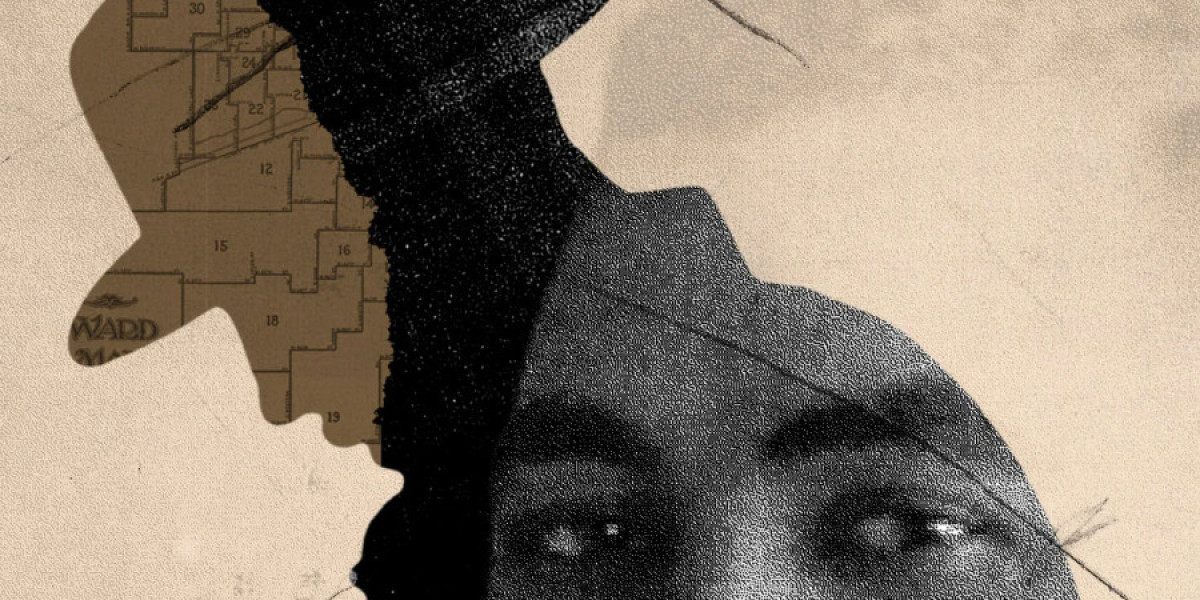

A little less than a decade before, Bruseaux had become, by all extant records, the United States’ first Black licensed private investigator. The industry was, at the time, a white man’s enterprise, with illustrious agencies such as Pinkerton and Baldwin-Felts marketing their services to the country’s moneyed elite. Bruseaux pitched his to Chicago’s growing Black bourgeoisie, who were beginning to suffer the same messy divorces and estate battles as their white counterparts. While Bruseaux snooped into embezzlement and infidelity—a private eye’s bread and butter—he also moonlighted as an avenger of racial violence, hunting perpetrators of lynchings and bombings. His advantage over his white competitors, Bruseaux would later claim, was his vast network of informants hidden in plain sight: Black cooks and cleaners and doormen, an army of service workers who received no second glances but were privy to the city’s whispers and confidences.
Though Bruseaux has since been neglected by history, he was once a household name in the Black community. But as he prepared to take on the Granady case, the biggest of his career, his public persona revealed only part of his story. He had become wealthy and famous by unearthing other people’s secrets, but the man known as Sheridan Bruseaux was keeping a few of his own.
On April 26, 1890, Sheridan Bruseau—the second to last of fifteen children, nine of whom survived past adolescence—was born in Little Rock, Arkansas. Sheridan’s father, Alexander, had been born into slavery on a sugar plantation in Louisiana, a land of serpentine bayous and long fields of swaying cane. In harvest season, cutting gangs waded into the tall grass, hacking at the stalks with flat, double-sided knives from dawn to dusk. Among Southern slaves, cane plantations inspired terror, so frequent was death from exhaustion, disease, or industrial accidents. (The famed abolitionist Frederick Douglass dubbed captivity on such plantations a “life of living death.”)
During the Civil War, when the Union Army marched into Louisiana, thousands of slaves dropped their blades and fled, many choosing to enlist with their liberators. In the summer of 1863, Alexander Bruseau, then 25, joined up and was mustered into the U.S. Colored Troops 79th Infantry. Following the Union’s final victory in 1865, Bruseau received $249.60 in military benefits from the Freedman’s Bureau and headed north to Arkansas. By the late 19th century, Little Rock was home to a thriving class of Black entrepreneurs and craftsmen. Most former slaves, though, had few marketable skills, and they were forced into menial work and subsistence incomes. Bruseau became a gardener. In 1877, he married a woman, Nancy, from North Carolina, with whom he had several children, including Sheridan. Their home, a simple frame shack near the city limits, sat in sight of a cemetery honoring the Confederate dead.
Under Jim Crow, Black Southerners were frequently subjected to spectacular violence. In 1904, when Sheridan was 14, the town of St. Charles, two counties over, became the site of one of the largest mass lynchings in U.S. history, in which 13 Black men were shot to death. Such brutal vigilantism often received the tacit support of journalists. Little Rock’s Arkansas Democrat once printed on its front page that a “black brute”—an alliterative phrase the publication had a special fondness for—accused of assaulting a “highly respected lady” was hanged from a telephone pole in the town of Tillar. The report noted that he had been left strung up for much of the next day. The alleged assailant was 17, only a year older than Sheridan.
After attending a local high school and then the recently established Arkansas Baptist College, Sheridan faced a cruelly delimited future. He took a series of low-paying service jobs—day laborer, messenger, porter. But soon an opportunity presented itself. With the onset of World War I, factories in northern cities began stamping out munitions and canned food. Word of higher wages and fairer treatment spread south. Between 1916 and 1919, around half a million Black Americans departed the rural districts of their birth for the North’s industrialized sprawl and hope of a more profitable, less frightening tomorrow. Sheridan, his mother, and many of his siblings were among them.
When Sheridan reemerged in Chicago, his last name was entered into the public record with an x on the end. Viewed one way, the addition was a simple embellishment—attempted evidence, perhaps, of an unprovable claim Bruseaux would later make to a journalist that he was of French descent. But it was also an act of reinvention. In the comparative safety of the North, Bruseaux was free to fashion a new self.
THANK YOU FOR REACHING THE END OF THE STORY. DON'T FORGET TO FOLLOW AND COMMENT.